ELECTRONIC MEASUREMENTS 2025-2026 - INP9086598
Résumé de section
-
“Electronic measurements” provides essential knowledge on instrumentation and measurement methods, with an emphasis on test and characterization of electronic devices and systems.
Laboratory activities aim at further developing the skills in understanding quantitative aspects, that professional electronic designers are expected to master. Attention is paid to the concepts of approximation and uncertainty, emphasizing the role of measurement as a bridge between reality and engineering models.
-
C. Narduzzi, A. Pozzebon - Electronic Measurements - Lecture Notes, Academic Year 2025/2026
Texts are available at the shops of Libreria Progetto.For locations and opening times, please consult: https://www.libreriaprogetto.it/home.htmlOn-line catalogue and purchase: https://www.libreriaprogetto.it/casa-editrice/catalogo-edizioni-libreria-progetto-padova.html (in Italian)
-
-
Laboratory activities will start in the second week of the course, on Wednesday, October 8th, 2025, with supervised step-by-step familiarization activities.
Laboratory activities are carried out by student groups. Please see the relevant laboratory guide for each activity.
The laboratory classroom can have up to 12-16 work benches equipped with measuring instruments. Teams are formed by up to three students each.
Registration is required to access the laboratory. All students must have preliminarily taken the required courses on safety (General plus Electrical risk).
Laboratory reports
Laboratory reports can be submitted for some of the activities, please see below.
Submissions are made on a voluntary basis and will be assessed as part of the exam final score. The following rules must be followed:
- reports are presented individually: each student is responsible for the contents of his/her report, regardless of the fact that laboratory activities involve student groups. Students are expected to carefully review their data and the associated computations before submitting reports;
- the format of the report form, that can be downloaded through this Moodle page, should be carefully followed;
- when data requested in the report form cannot be provided, the relevant item should be left blank, not deleted from the report;
- the report should be uploaded through this Moodle page as a single .pdf file;
- after the end of the relevant laboratory activity, two weeks are allowed for uploading the report.
IMPORTANT: reports submitted later than two weeks will not be considered.
-
Participation in laboratory activities requires prior registration to allow teams to be formed. Up to 12 teams with 3 students each are allowed.
Please ensure you have your own personal account at DEI, as only this will enable you to employ laboratory PCs for programmable instrumentation exercises. The account request form is found here, you will need your Single Sign-On (SSO) registration to access it.
-
Participation in laboratory activities requires prior registration to allow teams to be formed. Up to 12 teams with 3 students each are allowed in each of the two shifts.
Please ensure you have your own personal account at DEI, as only this will enable you to employ laboratory PCs for programmable instrumentation exercises. The account request form is found here, you will need your Single Sign-On (SSO) registration to access it.
-
Students are allowed access into the laboratory for supervised exercises provided they obtain, or already have the required safety certifications. On-line courses on safety are accessible for this purpose from the following web pages:CORSO BASE SULLA SICUREZZA: FORMAZIONE GENERALE (4 ore)
https://elearning.unipd.it/formazione/course/view.php?id=222BASIC COURSE IN HEALTH AND SAFETY: "GENERAL TRAINING" (4 hours - in English)https://elearning.unipd.it/formazione/course/view.php?id=249
https://elearning.unipd.it/formazione/course/view.php?id=223
HIGH-RISK ACTIVITIES (12 hours)Students will be required to read and agree to the laboratory guidelines and sign a statement that they have achieved the safety certification.IMPORTANT: a signed statement of certification (autocertificazione - self-statement) is a trusted document according to Italian Law. You are reminded that any signed false statement is a criminal offense.-
Ouvert : samedi 4 octobre 2025, 23:59Terminé : mercredi 17 décembre 2025, 23:59
Positive answer to all questions is a pre-condition for access to the laboratory.
Answering this feedback form replaces the written signature on the paper self-certification module that would otherwise be required.
-
-
-
Ouvert le : jeudi 30 octobre 2025, 16:30À rendre : samedi 15 novembre 2025, 16:30
Operational amplifier open-loop gain - Report Submission
Download the report .odt file, fill in with data obtained from laboratory measurements, convert the file into .pdf format (alternatively: download the pdf file, fill it in, then scan the result as a .pdf file).
Upload one pdf file through the report submission link given above.
You may choose to include additional information in the report file (e.g., oscilloscope screenshots taken during the exercise), but remember to upload a single pdf file.
You are reminded that reports are submitted individually.
Submission deadline: Saturday, 15 November 2025
-
LABORATORY SCHEDULE
Laboratory activities for November 5th, 12th and 19th will take place according to the following schedule:
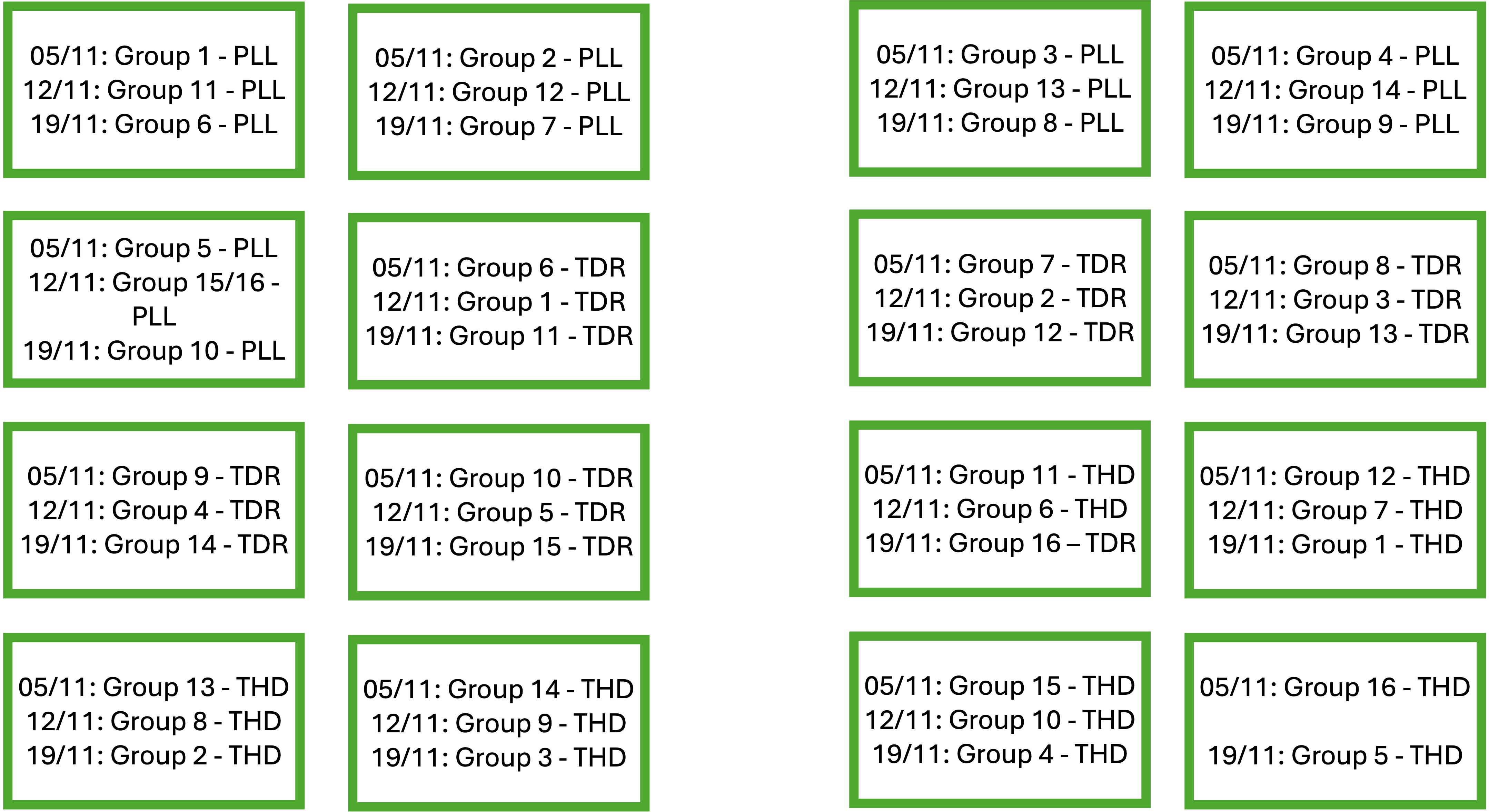
Please read carefully the laboratory guide IN ADVANCE. Relevant chapters are indicated beside each entry in the table above. In case of doubt, group compositions are reported in the general Section on "Laboratory Activities".
-
This guide covers the first three-week sequence of laboratory activity.
-
Ouvert le : jeudi 6 novembre 2025, 23:59À rendre : dimanche 30 novembre 2025, 23:59
Output distortion of a linear amplifier (THD)
Reference: Laboratory guide - Part A, Chapter 1
Download the report .odt file, fill in with data obtained from laboratory measurements, convert the file into .pdf format (alternatively: download the pdf file, fill it in and scan the result).
Upload a pdf file through the report submission link given here (total allowed: 1 file).
You may choose to upload oscilloscope screenshots taken during the exercise. These must be included in the pdf file.
You are reminded that reports are to be submitted individually.Submission deadline: Sunday, 30 November 2025
-
Ouvert le : jeudi 6 novembre 2025, 23:59À rendre : dimanche 30 novembre 2025, 23:59
Time-domain reflectometry (TDR)
Reference: Laboratory guide - Part A, Chapter 2Download the report .odt file, fill in with data obtained from laboratory measurements, convert the file into .pdf format (alternatively: download the pdf file, fill it in and scan the result).
Upload a pdf file through the report submission link given here (total allowed: 1 file).
You may choose to upload oscilloscope screenshots taken during the exercise. These must be included in the pdf file.
You are reminded that reports are to be submitted individually.Submission deadline: Sunday, 30 November 2025
-
Ouvert le : jeudi 6 novembre 2025, 23:59À rendre : dimanche 30 novembre 2025, 23:59
Phase Locked Loop characterization (PLL)
Reference: Laboratory guide - Part A, Chapter 3Download the report .odt file, fill in with data obtained from laboratory measurements, convert the file into .pdf format (alternatively: download the pdf file, fill it in and scan the result).
Upload a pdf file through the report submission link given here (total allowed: 1 file).
You may choose to upload oscilloscope screenshots taken during the exercise. These must be included in the pdf file.
You are reminded that reports are to be submitted individually.Submission deadline: Sunday, 30 November 2025
-
-
LABORATORY SCHEDULE
Laboratory activities for November 26th, December 3rd and 17th and January 7th will take place according to the following schedule:
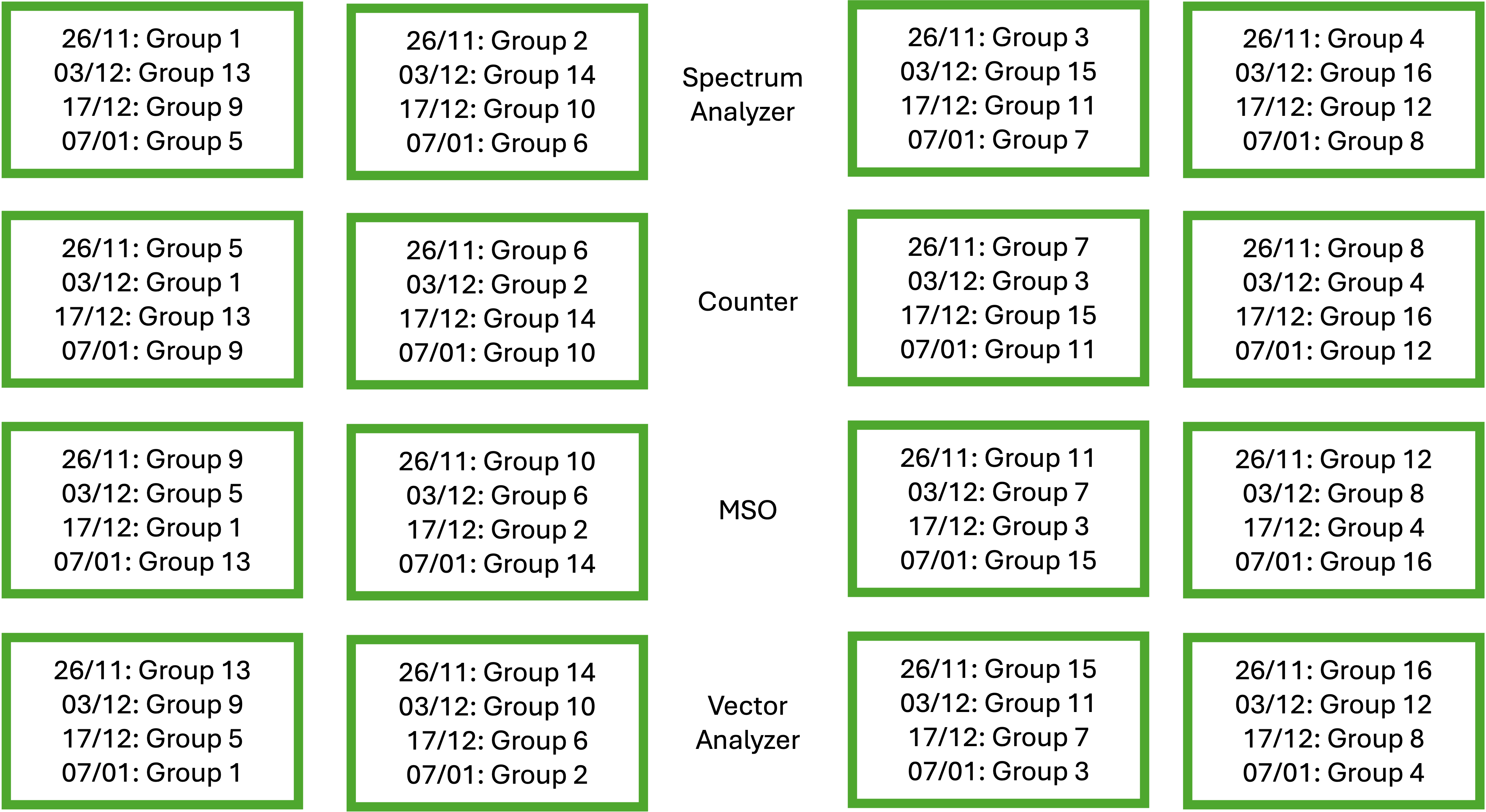
Please read carefully the laboratory guide IN ADVANCE. Relevant chapters are indicated beside each entry in the table above. In case of doubt, group compositions are reported in the general Section on "Laboratory Activities".
-
This guide covers the second four-week period of laboratory activities
-
-
References
Electronic Measurements - Lecture notes 2025/2026
Electronic Measurements - Laboratory guide, Part A
Electronic Measurements - Laboratory guide, Part B
-
This is a collection of questions prepared some years ago, and taken from written and oral exams covering a 10-year time span. As such they present a selection of topics, both theory and numerical exercises, that may help check your preparation.
DISCLAIMER:
Texts are just representative examples, but are not intended to be exhaustive of exam topics. The complete list of topics is given in the examination programme.
-
-
Exams comprise a written part followed by an oral part.Note: students may register for the oral part of the exam only after the written part has been passed in the same session.Expected exam dates are reported below.
written 21 January 2026 12:00 oral from 26 January 2026 10:00 written 11 February 2026 10:00 oral from 16 February 2026 10:00 written 17 June 2026 14:00 oral from 22 June 2026 10:00 written 22 September 2026 14:00 oral from 24 September 2026 10:00 PLEASE NOTETo help them arrange their exam schedule as best as possible, students are reminded that:- The Winter session provides two dates for students to take thier exam: they may select any of the two;
- A negative outcome on the first date does not prevent students from taking the exam also on the second date in the session;
- For this course, students are allowed to split the exam, that is, taking the written part on a date (e.g., January) and deferring the oral part to another date (e.g., February)
-
-
Thinking about adding further contents in measurement and instrumentation to your curriculum?
Remember you may always add a course of your liking to your learning agreement (piano di studio) as a free-choice course (corso a scelta libera).
Here's some ideas:
Electromagnetic compatibility - In an ideal world, your electronic design will always work fine since first time... but you might need some help to achieve that in the real world. Electromagnetic fields and stray currents have a mind of their own, and seemingly like to play nasty tricks on your designs. That is, unless you can manage signal integrity and electromagnetic compatibility design criteria.
- Measurement architectures for cyber-physical systems - Put an embedded microcontroller, a few sensors and some network interface into a box, mix and shake, and there you have it... a real mess. You definitely need design criteria to go cyberphysical, and maybe succeed in implementing an IoT node than can produce true measurements, rather than turn out random numbers.
- Wearable sensing design for healthcare - Systems design means acknowledging that your clever circuit/sensor/processor will operate in concert with so many other things. Understanding the full picture is part of your design tasks, and nowhere is this more apparent than in the healthcare world. Learn to get out of your comfort zone and interact with different engineering fields.
- Quality engineering - Engineers are usually hired to turn bright ideas into products. Companies like to think of this as a set of inter-related processes, tasks, goals, etc. Quality means... lots of things actually, but the basics still are "say what you do, and do what you say". With some sound rules that may help you, if you are interested.