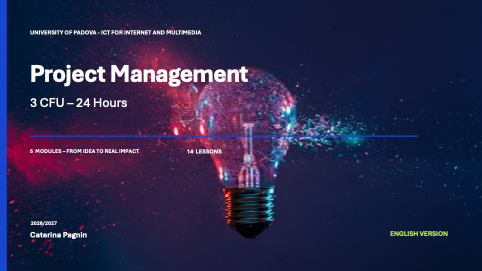
Project Management is an essential practice for any organization seeking to succeed. It is estimated that 68% (PMI source) of projects achieve their original goals and business intent, while investing 28 times less capital in operational activities.
The purpose of this course is to provide a general understanding of project management, examining it from different perspectives and covering specific practices that are currently used to manage projects effectively and efficiently.
The course will also provide an understanding of the role of the Project Manager in modern organizations, highlighting the responsibilities, competencies, and decision-making skills required to lead teams and stakeholders towards the achievement of project objectives.
Real examples and practical cases will be presented to connect theoretical concepts with typical business project challenges, fostering a practical, results-oriented perspective.
What you will learn
• develop an understanding of fundamental project management terminology;
• initiate a project successfully;
• identify and structure a project’s scope;
• manage project schedules;
• estimate, monitor, and control project costs using Earned Value Management (EVM);
• compare different project management approaches.
By the end of the course, students will also be able to:
• understand the project life cycle and its main phases;
• identify and analyze project risks and opportunities;
• use tools for planning and monitoring activities;
• understand the role of stakeholders and the main project communication techniques;
• assess the strengths and limitations of the main Project Management frameworks.
In addition, the course provides an essential comprehensive overview of project management using both waterfall and agile approaches, highlighting their differences and exploring potential ways to integrate them.
Particular attention will be assigned to balancing the technical, organizational, and interpersonal aspects that characterize the management of complex projects.
The purpose of this course is to provide a general understanding of project management, examining it from different perspectives and covering specific practices that are currently used to manage projects effectively and efficiently.
The course will also provide an understanding of the role of the Project Manager in modern organizations, highlighting the responsibilities, competencies, and decision-making skills required to lead teams and stakeholders towards the achievement of project objectives.
Real examples and practical cases will be presented to connect theoretical concepts with typical business project challenges, fostering a practical, results-oriented perspective.
What you will learn
• develop an understanding of fundamental project management terminology;
• initiate a project successfully;
• identify and structure a project’s scope;
• manage project schedules;
• estimate, monitor, and control project costs using Earned Value Management (EVM);
• compare different project management approaches.
By the end of the course, students will also be able to:
• understand the project life cycle and its main phases;
• identify and analyze project risks and opportunities;
• use tools for planning and monitoring activities;
• understand the role of stakeholders and the main project communication techniques;
• assess the strengths and limitations of the main Project Management frameworks.
In addition, the course provides an essential comprehensive overview of project management using both waterfall and agile approaches, highlighting their differences and exploring potential ways to integrate them.
Particular attention will be assigned to balancing the technical, organizational, and interpersonal aspects that characterize the management of complex projects.
- Docente: Caterina Pagnin