Discover distant worlds. Build tools that reach beyond them.
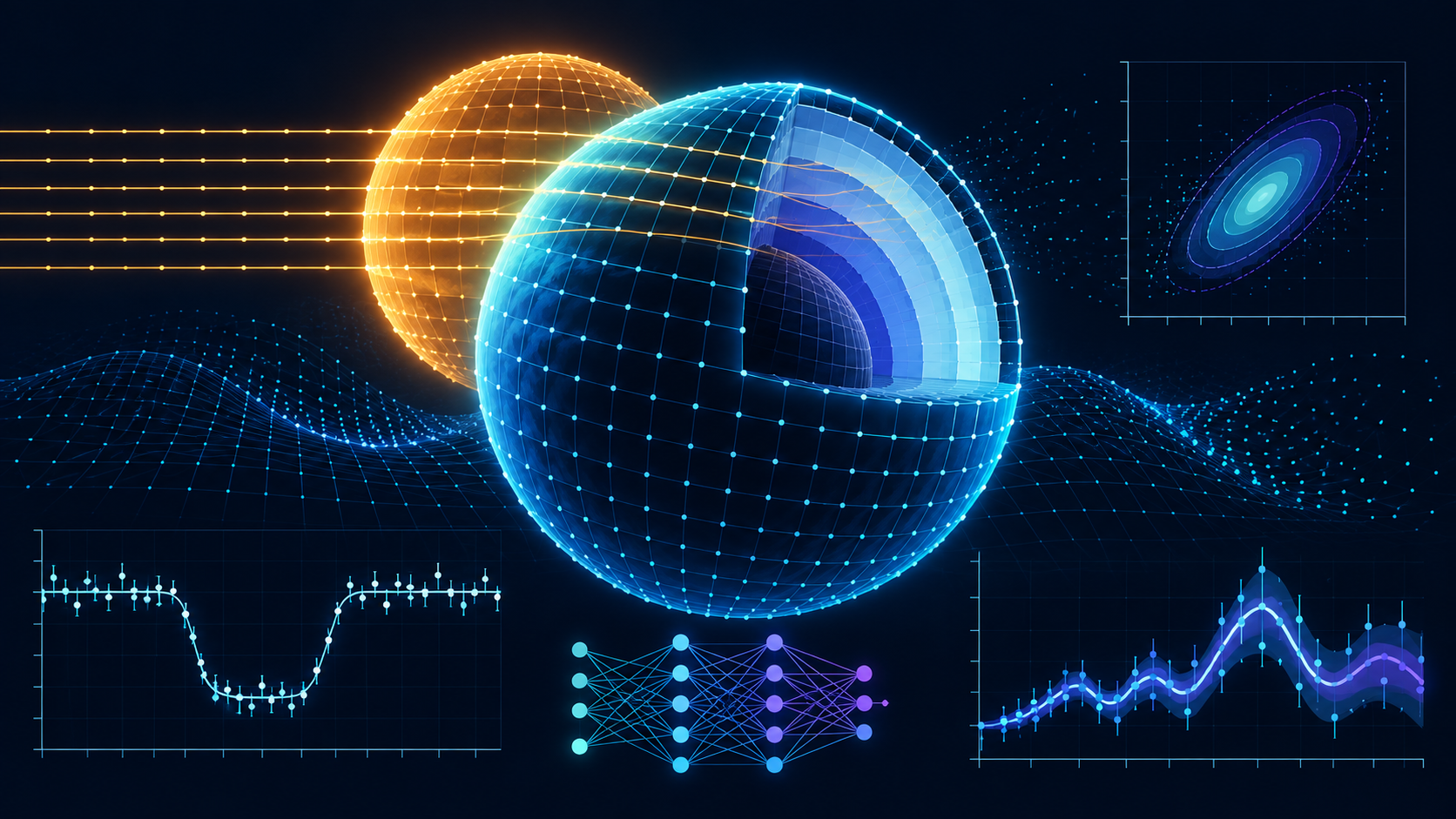
A tiny dip in starlight can reveal a planet. Subtle features in its transmission spectrum can reveal clues to its atmosphere. In Computational Astrophysics, these discoveries become your laboratory for learning how to turn data into physical understanding—and how to build the software that makes it possible.
Through lectures and hands-on laboratories, you will combine Python, machine learning, numerical modelling, and Bayesian inference to develop your own scientific toolkit. Working in teams of 3–4, you will build a documented, reproducible Python package with two connected modules:
- Transit detection: identify planetary signals in Kepler and TESS light curves using machine-learning methods.
- Atmospheric analysis: connect transmission spectra with physical models to constrain atmospheric properties and quantify uncertainty.
You will explore radiative transfer and atmospheric retrieval, including the use of TauREx, and apply your skills to a final investigation of an exoplanet observed with the James Webb Space Telescope. Along the way, you will practise collaborative development with Git, code integration and validation, documentation, and scientific communication.
Exoplanets are the starting point; the skills extend across astrophysics and modern industry. Signal detection, machine learning, numerical modelling, and statistical inference provide a common computational foundation across astrophysical branches—from stellar physics and galaxy evolution to cosmology and gravitational-wave astronomy. These same methods support industrial applications such as anomaly detection, predictive maintenance, parameter estimation, and engineering optimisation. The tools you develop will give you reusable building blocks for tackling new problems, together with the judgement to adapt and validate them.
No previous astrophysics knowledge is required. Bring your foundations in programming, mathematics, physics, and statistics—and your curiosity about what you can discover and build.
A tiny dip in starlight can reveal a planet. Subtle features in its transmission spectrum can reveal clues to its atmosphere. In Computational Astrophysics, these discoveries become your laboratory for learning how to turn data into physical understanding—and how to build the software that makes it possible.
Through lectures and hands-on laboratories, you will combine Python, machine learning, numerical modelling, and Bayesian inference to develop your own scientific toolkit. Working in teams of 3–4, you will build a documented, reproducible Python package with two connected modules:
- Transit detection: identify planetary signals in Kepler and TESS light curves using machine-learning methods.
- Atmospheric analysis: connect transmission spectra with physical models to constrain atmospheric properties and quantify uncertainty.
You will explore radiative transfer and atmospheric retrieval, including the use of TauREx, and apply your skills to a final investigation of an exoplanet observed with the James Webb Space Telescope. Along the way, you will practise collaborative development with Git, code integration and validation, documentation, and scientific communication.
Exoplanets are the starting point; the skills extend across astrophysics and modern industry. Signal detection, machine learning, numerical modelling, and statistical inference provide a common computational foundation across astrophysical branches—from stellar physics and galaxy evolution to cosmology and gravitational-wave astronomy. These same methods support industrial applications such as anomaly detection, predictive maintenance, parameter estimation, and engineering optimisation. The tools you develop will give you reusable building blocks for tackling new problems, together with the judgement to adapt and validate them.
No previous astrophysics knowledge is required. Bring your foundations in programming, mathematics, physics, and statistics—and your curiosity about what you can discover and build.
- Docente: Tiziano Zingales