Welcome to Systems Laboratory!
Why this course?
Control systems are a core technology behind many systems that affect our daily lives: robotics, industrial automation, energy and transport systems, biomedical devices, and many forms of autonomy. In this course, control is not presented as “a bag of formulas”, but as a way of reasoning about dynamical systems: modelling how things change over time, predicting consequences, and designing interventions—often using feedback—so that systems behave reliably, efficiently, and safely.
This course is a foundation layer in the control curriculum. If the foundations are solid, advanced topics later on (state space, stability analysis, optimal control, MPC) will feel coherent and natural. If the foundations are weak, those same topics often feel like isolated tricks. Our focus is therefore depth and conceptual understanding.
How the learning material is structured (and why you will see many PDFs)
The slides are organized in modules, each module answering one “natural question” (for example: “How can we simulate an ODE?”). Each module is written once, and compiled into multiple PDFs, each representing a different “view” of the same content:
- Main (used in class): a guided conceptual journey (not meant to be exhaustive notes)
- ILOs: what you should be able to do after completing the module
- Assess: self-assessment both on prerequisites (PLOs) and on the module outcomes (ILOs)
- Recaps: a deliberate distinction between concepts (what things mean) and procedures (how to do things)
- Reflect: reflection prompts to consolidate, connect ideas, and strengthen metacognition
This structure is deliberate: objectives, learning activities, and assessment are meant to be aligned.
Recommended workflow (how to study efficiently)
1) Before class — self-assessment on the PLOs (readiness check)
If prerequisites are shaky, the in-class part will feel much harder. Use the PLO self-assessment to detect and fix gaps early.
2) In class — ILOs + Main slides, peer instruction, discussion
We will use peer instruction frequently: answer individually, discuss in small groups, then answer again individually. The goal is not “voting”, but exposing your mental model and improving it through structured discussion.
3) After class — self-assessment on the ILOs (mastery check)
“I followed in class” is not the same as “I can use the concept”. The ILO self-assessment is where you verify real understanding.
4) Cyclically — recaps + reflection
Recaps and reflections are not “extra stuff”: they are how you improve retention and transfer, and how you build a coherent map of the course.
Assessment (overview)
The exam includes:
- Pre-written test: 10 MCQs selected from a public database with solutions (high passing threshold by design)
- Written exam: a mix of MCQs and open questions
- Oral exam: short (10 minutes) to test depth, flexibility, and understanding beyond pattern-matching
These formats are intentionally different: they assess precision, structured reasoning, and the ability to explain. Please check the rubrics on Moodle early: they are not bureaucratic documents, but alignment maps showing what “quality” means.
Extra points, labs, and capstone
Extra points reward engagement beyond the minimum:
- active participation
- creating/improving shareable learning material (code, questions, plots, drawings; licensing: CC0)
- capstone project (automatic plant watering system)
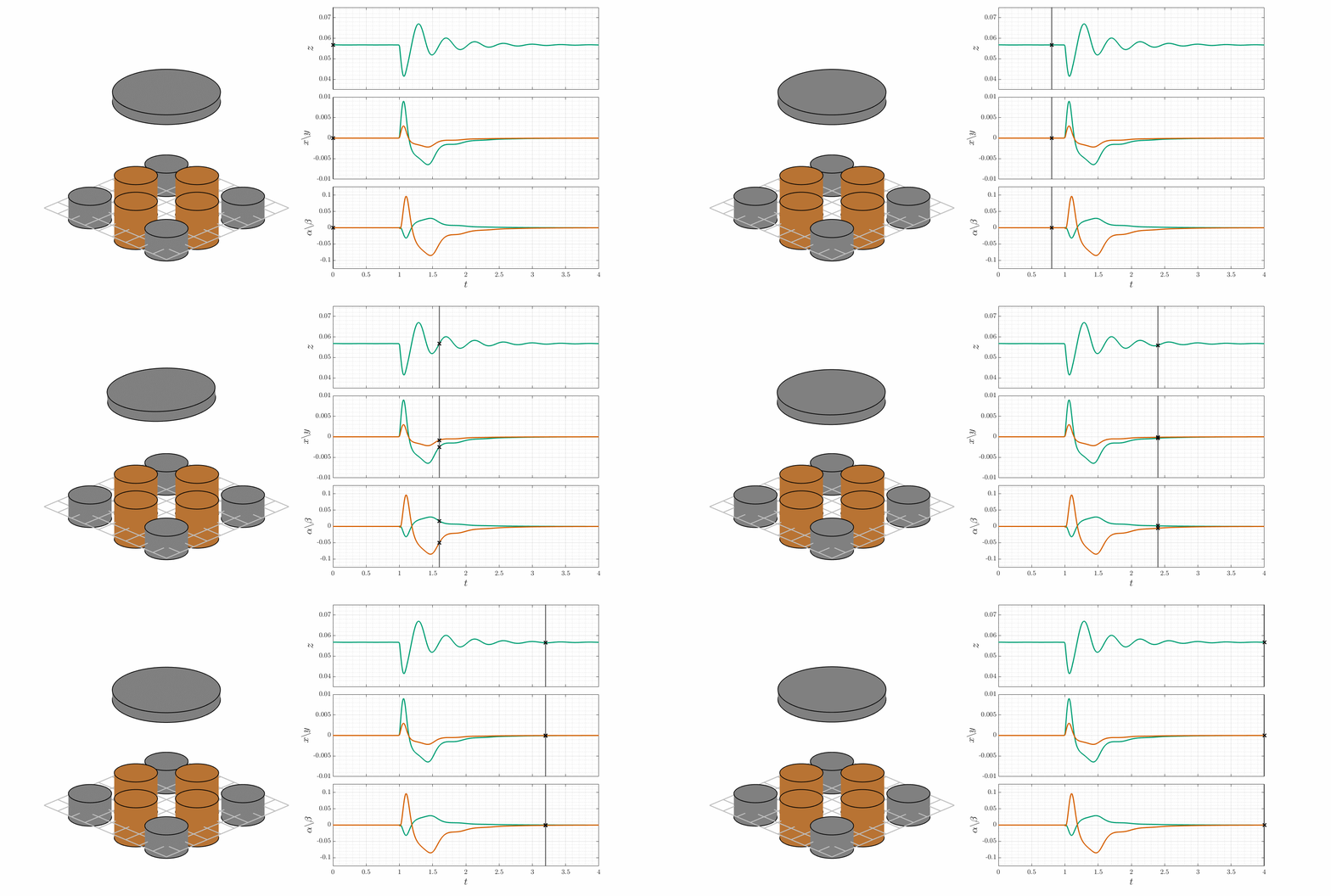
Labs are optional but strongly recommended: they connect abstract models to real behavior, including non-idealities (noise, delay, saturation, discretization). Labs use both Python and MATLAB/Simulink, and optionally the take-home Maglev system (“Maggy”).
Tools to help your learning
You are welcome to use AI tools (e.g., ChatGPT) to quiz yourself, debug code, and ask for explanations—just be careful not to delegate mindlessly. We will also use Exerplaza as a tool to support self-assessment and metacognitive monitoring.
Why this course?
Control systems are a core technology behind many systems that affect our daily lives: robotics, industrial automation, energy and transport systems, biomedical devices, and many forms of autonomy. In this course, control is not presented as “a bag of formulas”, but as a way of reasoning about dynamical systems: modelling how things change over time, predicting consequences, and designing interventions—often using feedback—so that systems behave reliably, efficiently, and safely.
This course is a foundation layer in the control curriculum. If the foundations are solid, advanced topics later on (state space, stability analysis, optimal control, MPC) will feel coherent and natural. If the foundations are weak, those same topics often feel like isolated tricks. Our focus is therefore depth and conceptual understanding.
How the learning material is structured (and why you will see many PDFs)
The slides are organized in modules, each module answering one “natural question” (for example: “How can we simulate an ODE?”). Each module is written once, and compiled into multiple PDFs, each representing a different “view” of the same content:
- Main (used in class): a guided conceptual journey (not meant to be exhaustive notes)
- ILOs: what you should be able to do after completing the module
- Assess: self-assessment both on prerequisites (PLOs) and on the module outcomes (ILOs)
- Recaps: a deliberate distinction between concepts (what things mean) and procedures (how to do things)
- Reflect: reflection prompts to consolidate, connect ideas, and strengthen metacognition
This structure is deliberate: objectives, learning activities, and assessment are meant to be aligned.
Recommended workflow (how to study efficiently)
1) Before class — self-assessment on the PLOs (readiness check)
If prerequisites are shaky, the in-class part will feel much harder. Use the PLO self-assessment to detect and fix gaps early.
2) In class — ILOs + Main slides, peer instruction, discussion
We will use peer instruction frequently: answer individually, discuss in small groups, then answer again individually. The goal is not “voting”, but exposing your mental model and improving it through structured discussion.
3) After class — self-assessment on the ILOs (mastery check)
“I followed in class” is not the same as “I can use the concept”. The ILO self-assessment is where you verify real understanding.
4) Cyclically — recaps + reflection
Recaps and reflections are not “extra stuff”: they are how you improve retention and transfer, and how you build a coherent map of the course.
Assessment (overview)
The exam includes:
- Pre-written test: 10 MCQs selected from a public database with solutions (high passing threshold by design)
- Written exam: a mix of MCQs and open questions
- Oral exam: short (10 minutes) to test depth, flexibility, and understanding beyond pattern-matching
These formats are intentionally different: they assess precision, structured reasoning, and the ability to explain. Please check the rubrics on Moodle early: they are not bureaucratic documents, but alignment maps showing what “quality” means.
Extra points, labs, and capstone
Extra points reward engagement beyond the minimum:
- active participation
- creating/improving shareable learning material (code, questions, plots, drawings; licensing: CC0)
- capstone project (automatic plant watering system)
Labs are optional but strongly recommended: they connect abstract models to real behavior, including non-idealities (noise, delay, saturation, discretization). Labs use both Python and MATLAB/Simulink, and optionally the take-home Maglev system (“Maggy”).
Tools to help your learning
You are welcome to use AI tools (e.g., ChatGPT) to quiz yourself, debug code, and ask for explanations—just be careful not to delegate mindlessly. We will also use Exerplaza as a tool to support self-assessment and metacognitive monitoring.
- Docente: Damiano Varagnolo